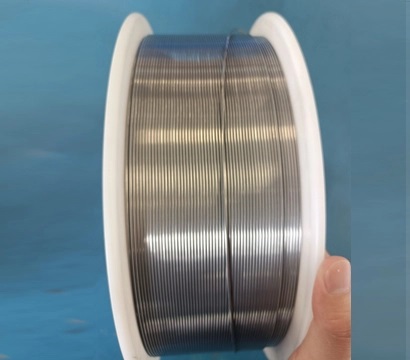
What Materials Are Hardfacing Flux Cored Wires Made Of?
Alloy Chemical Composition
The most commonly used surfacing alloy is high-chromium iron, which has a precise chromium content of one-third and a carbon content exceeding 4%.
This standard alloy can be improved in various ways; it can increase wear resistance while reducing toughness, and vice versa. Conversely, the hardness of the matrix can be increased by lowering the manganese content to 1%, though the toughness will be somewhat reduced. Additionally, other alloying elements can be added to further refine the alloy.
Carbides
The wear resistance of high-chrome powder alloys is due to the formation of primary carbides from compounds of iron, chromium, and carbon (or iron-chromium or carbides), also known as chromium carbide. Pure, high-purity chromium carbide can be produced, but it is costly for large-scale protection.
Hardness
Standard overlay alloys consist of chromium-carbide compounds within a chromium-iron-carbon alloy matrix. The hardness of primary chromium carbide is about 1700HV. For instance, a common workshop steel file has a hardness of 600HV. Typically, these alloys' hardness can be measured with a Rockwell hardness tester. Although the Rockwell hardness tester does not measure the hardness of either the carbides or the matrix, it provides a good reflection of the overall alloy's hardness. The average hardness is 54-60 HRC.
Microstructure
Chemically, the most important feature of the alloy overlay is its microstructure. Thus, when observed under a microscope, the carbides appear as white substances against a dark background matrix. For superior wear resistance, a perfect microstructure must have densely packed acicular carbides, whose cross-sections form elongated hexagons with a small hole in the center.
Additionally, if irregular shapes of white spots or traces are observed, such as stair-like, fishbone-like, or any central column with crossbars on the sides, further examination is necessary. This is a clear signal indicating that the carbon content is below the optimal value for high wear resistance, but it also increases impact resistance.
Typical Applications of Hardfacing Flux Cored Wires
Mining Equipment
e.g., Jaw plates, hammers, liners, screen plates
Main wear forms: Impact + Ore wear
Recommended wires: High manganese steel type or composite carbide wires
Cement and Building Materials Industry
e.g., Vertical mill rollers, grinding plates, conveying screws
Main wear forms: Hard particle abrasive wear
Recommended wires: High Cr alloy wires or composite carbide type
Power Industry
e.g., Pulverized coal pipelines, fan blades, burner nozzles
Main wear forms: High-temperature corrosion + High-speed airflow erosion
Recommended wires: High-temperature and corrosion-resistant Cr-Mo alloy wires
Agricultural Machinery
e.g., Plowshares, straw choppers, mixer blades
Wear forms: Soil abrasive erosion
Recommended wires: Economic carbide wires
Petrochemical Industry
e.g., Drill bits, oil pipe inner walls, ball valve sealing surfaces
Characteristics: High corrosion, high temperature
Recommended wires: Corrosion-resistant wires containing Ni, Mo, etc.
Hardfacing flux cored wires play a significant role in industrial equipment remanufacturing and surface enhancement due to their high hardness, customizable alloy design, and excellent welding performance. Different application scenarios correspond to different alloy systems. Selecting the appropriate electrode wire can significantly extend equipment life, save maintenance costs, and improve production efficiency.

.webp "Medium Frequency Butt Welding Machine for Copper-Aluminum Tube")