Choosing the right hardfacing flux cored wire depends mainly on the required hardness level (HRC), the dominant wear mechanism, welding environment, and application conditions. For abrasion, impact, metal-to-metal wear, or high-temperature service, different flux core hardfacing wires provide different balances of hardness, toughness, and crack resistance. This guide explains how to select hardfacing welding wire by HRC and wear type, helping fabricators and maintenance teams match welding consumables with real operating conditions.
Understanding Hardfacing Flux Cored Wire and HRC Selection
Hardfacing flux cored wire is a tubular welding consumable designed to deposit wear-resistant alloy layers onto metal components. The deposited weld overlay improves service life by protecting surfaces against abrasion, impact, erosion, and friction. According to the definition of hardfacing, the process involves applying a wear-resistant material onto the surface of a base metal to extend its operating life.
Hardness, usually measured by Rockwell C (HRC), is one of the most important selection factors. However, higher hardness does not always mean better performance. A very hard overlay may resist abrasion but can crack under heavy impact. Therefore, the correct wire must balance hardness and toughness.
Wear Condition | Typical HRC Range | Recommended Wire Characteristics |
Mild abrasion | 45–55 HRC | Good toughness and machinability |
Severe abrasion | 55–65 HRC | High chromium carbide content for maximum wear resistance |
Impact + abrasion | 50–60 HRC | Balanced hardness and crack resistance |
Metal-to-metal wear | 45–60 HRC | Low friction alloy structure with good toughness |
Extreme wear | 60+ HRC | High carbide volume deposit for severe service conditions |
How Wear Type Determines Flux Core Hardfacing Wire Choice
Wear behavior is usually more important than hardness alone. Understanding the actual failure mode of a component helps avoid selecting an unsuitable welding wire. For severe abrasion environments, products such as MH-D577 hardfacing flux cored welding wire can be considered when a higher wear-resistant overlay is required.
What hardfacing wire is suitable for abrasive wear?
Abrasive wear occurs when hard particles remove material from a surface. Components such as crushers, buckets, conveyor parts, and mining equipment often experience this type of damage.
For abrasive applications, chromium-rich flux cored wires are commonly selected because carbide structures provide excellent resistance against cutting and grinding action. A higher HRC deposit can improve wear resistance when impact levels are limited.
What wire should be used for impact and abrasion?
When equipment receives repeated shock loads, extremely hard deposits may fracture. Applications such as excavator teeth, crusher parts, and heavy-duty machinery often require a compromise between hardness and toughness.
Flux core hardfacing wire with alloy additions such as chromium, manganese, or molybdenum can provide better crack tolerance while maintaining wear resistance.
Selecting Gasless Hardfacing MIG Wire for Field Applications
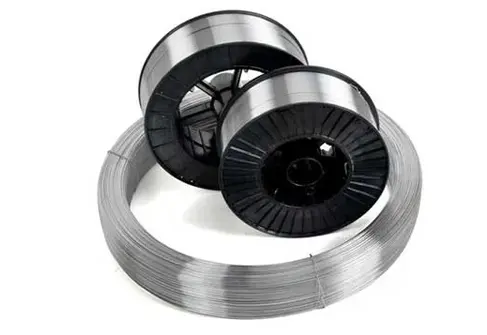
Gasless hardfacing MIG wire, also known as self-shielded flux cored wire, is widely used for outdoor maintenance because it does not require external shielding gas. This welding method is based on the principles of flux-cored arc welding, where the tubular wire contains flux ingredients that help stabilize the arc and protect the weld pool during welding.
When should gasless hardfacing MIG wire be used?
Gasless wire is suitable for construction sites, mining repairs, agricultural equipment maintenance, and locations where wind makes gas shielding difficult.
Advantages include:
- No shielding gas requirement
- Better portability for field repairs
- Good deposition efficiency
- Suitable for outdoor welding conditions
However, welding parameters, base metal preparation, and operator skill still influence final overlay quality.
Practical Hardfacing Flux Cored Wire Selection Guide
Before selecting a product, evaluate:
1. Wear mechanism: abrasion, impact, erosion, or friction.
2. Required hardness: determine the operating HRC target.
3. Base material: check compatibility with carbon steel, alloy steel, or cast components.
4. Welding position: consider flat, horizontal, or all-position welding needs.
5. Repair environment: choose gas-shielded or gasless welding solutions, including suitable hardfacing mig wire gas options for different welding conditions.
A practical selection process should focus on extending component life rather than choosing the highest hardness available.
Recommended Hardfacing Flux Cored Wire Solutions
For industrial users, AMH provides different hardfacing welding consumables designed for various wear conditions. One option for general wear-resistant overlay applications is MH-D517 hardfacing flux cored welding wire, which is designed for users looking for reliable deposition performance and durable surface protection.
Recommended product categories:
- High chromium hardfacing flux cored wire for severe abrasion applications
- Wear-resistant flux cored wire for mining and construction equipment
- Gasless hardfacing MIG wire for outdoor maintenance projects
- Multi-purpose flux core hardfacing wire for general repair welding
Frequently Asked Questions
What HRC hardness is best for hardfacing wire?
The ideal HRC depends on the wear condition. Abrasion applications often require higher hardness, while impact applications need a balance between hardness and toughness.
Is higher HRC always better for wear resistance?
No. Extremely high hardness may reduce impact resistance and increase cracking risk. The correct alloy depends on the operating environment.
What is the difference between flux core hardfacing wire and solid welding wire?
Flux cored wire contains internal flux ingredients that help create alloy deposits and improve welding performance. It is often preferred for high deposition repair work.
Can gasless hardfacing MIG wire be used outdoors?
Yes. Gasless flux cored wire is designed for outdoor conditions because it does not rely on external shielding gas.
Selecting the correct product according to HRC and wear type can reduce downtime and improve maintenance efficiency. If you need help choosing the right hardfacing flux cored wire for your specific application, contact us for technical guidance and product recommendations.
References
Hardfacing – Wikipedia
https://en.wikipedia.org/wiki/Hardfacing
Flux-cored arc welding – Wikipedia
https://en.wikipedia.org/wiki/Flux-cored_arc_welding