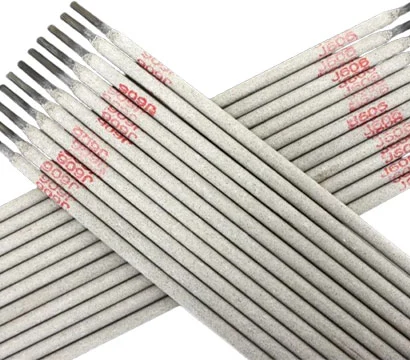
E7016 and E7018 are both low-hydrogen, high-strength SMAW (Shielded Metal Arc Welding) electrodes used for structural and pressure welding, but they differ in usability, arc stability, moisture resistance, and application preference. In short, E7018 is the most widely used general-purpose low-hydrogen electrode, while E7016 is a less common, slightly more stable-arc variant often preferred in specific AC welding conditions and root pass control scenarios. Choosing between them depends on base metal type, welding position, required mechanical properties, and site conditions.
What E7016 and E7018 Mean (Specification Breakdown)
Understanding the AWS classification is essential before comparing them:
Both E7016 and E7018 follow the AWS A5.1 electrode classification system:
E = Electrode
70 = Minimum tensile strength of 70,000 psi
1 = All-position welding capability (flat, horizontal, vertical, overhead)
6 / 8 = Flux coating type and welding current usability
E7018 Meaning
E7018 is a low-hydrogen iron powder electrode with a smooth, stable arc and high deposition efficiency. It is designed for:
AC or DC+ (DC reverse polarity) operation
High ductility and crack resistance
Structural steel welding with strict quality requirements
E7016 Electrode Specification
E7016 is also a low-hydrogen electrode, but with a different coating formulation that provides:
Better arc stability on AC in some conditions
Slightly softer arc compared to E7018
Good control for root passes and thin sections
For carbon steel welding electrode e7016 manufacturing, coating consistency, hydrogen control, current compatibility, and batch-level mechanical performance are essential quality considerations. Both belong to the same strength class, but their welding behavior differs in practice.
Key Differences Between E7016 and E7018
While they share the same tensile strength rating, their performance characteristics vary significantly in real-world welding.
1. Arc Characteristics
E7018: Very smooth, stable arc with minimal spatter. Ideal for production welding.
E7016: Slightly softer and more controllable arc, especially useful in AC welding systems with unstable power.
2. Hydrogen Control and Crack Resistance
Both electrodes are low-hydrogen, but controlling hydrogen levels is critical because excessive hydrogen can increase the risk of cracking through hydrogen embrittlement mechanisms:
E7018: Industry standard for critical welds requiring maximum crack resistance.
E7016: Still low hydrogen but less commonly used in heavy structural codes.
3. Deposition Rate and Efficiency
E7018: Contains iron powder → higher deposition rate → faster welding.
E7016: Slightly lower deposition efficiency but better control in root passes.
4. Welding Position Performance
Both are all-position electrodes, but:
E7018: Preferred for fill and cap passes
E7016: Often chosen for root and positional control work
5. Storage Sensitivity
E7018: Highly sensitive to moisture; must be stored in a heated oven (typically 120–150°C).
E7016: Slightly more forgiving, but still requires dry storage for low-hydrogen performance.
Applications and Welding Scenarios
Choosing between E7016 and E7018 depends heavily on the application environment and quality requirements. Both electrodes are commonly applied in Shielded Metal Arc Welding (SMAW), a manual welding process that uses a flux-coated electrode to create the arc and provide shielding during welding.
E7018 Typical Applications
Steel structures (buildings, bridges). Pressure vessels and pipelines. Heavy machinery fabrication. Offshore and offshore repair welding. Code-compliant structural welding (AWS D1.1)
Because of its mechanical reliability, E7018 is the default choice in most industrial standards. For higher-strength low-alloy steel applications, E7018 may not always provide the required strength matching or low-temperature impact performance. Projects involving WB36 or WB36CN1 steel, high-pressure feedwater pipelines and critical pressure-bearing components should review the AWS A5.5 E9018-G electrode specification and confirm the final consumable selection according to the project WPS.
E7016 Typical Applications
Root pass welding where arc control is critical. Thin plate steel fabrication. Repair welding in less controlled environments. AC-only welding machines or unstable power supply conditions
In practice, E7016 electrode is more of a special-use electrode, while E7018 is a general production standard.
How to Choose Between E7016 and E7018
Selecting the correct electrode should be based on engineering requirements rather than preference alone. Below is a practical decision framework used in industrial welding operations.
Choose E7018 if:
You need certified structural welds. You are welding pressure-bearing components. DC welding power source is available. Maximum tensile strength and ductility are required. You are working under AWS/ASME codes. Then you can choose E7018.
Choose E7016 if:
You are using AC welding equipment. You need better arc stability in root passes. You are working with thinner steel sections. Field conditions make arc control difficult.
Hybrid Industrial Practice
In many fabrication shops, both are used together:
E7016 → root pass
E7018 → fill and cap passes
This combination improves penetration control while maintaining high structural strength.
Quick Comparison Table: E7016 vs E7018
Feature | E7016 | E7018 |
Tensile Strength | 70,000 psi | 70,000 psi |
Coating Type | Low-hydrogen rutile blend | Low-hydrogen iron powder |
Arc Stability | Moderate, AC-friendly | Very smooth, stable |
Deposition Rate | Medium | High |
Crack Resistance | High | Very high |
Typical Use | Root pass, AC welding | Structural, production welding |
Storage Requirement | Dry storage | Oven storage required |
FAQ: E7016 vs E7018 Welding Electrodes
1. Is E7016 stronger than E7018?
No. Both E7016 and E7018 electrode welding rod have the same tensile strength rating (70,000 psi). The difference is in arc behavior and usability, not strength.
2. Can I replace E7018 with E7016?
In some AC welding scenarios, yes. However, for structural or code-certified work, E7018 is usually required.
3. Why is E7018 more popular than E7016?
Because E7018 offers better arc stability, higher deposition efficiency, and is widely accepted in welding codes.
4. Which electrode is better for beginners?
E7018 is generally easier for consistent production welding, while E7016 may require more control in technique.
5. Do both electrodes need to be kept dry?
Yes. Both are low-hydrogen electrodes and must be stored properly to avoid moisture absorption and hydrogen cracking risks.
References
Shielded Metal Arc Welding (SMAW) – Wikipedia
https://en.wikipedia.org/wiki/Shielded_metal_arc_welding
Hydrogen Embrittlement – Wikipedia
https://en.wikipedia.org/wiki/Hydrogen_embrittlement