In heavy industrial operations such as mining, cement manufacturing, dredging, and chemical processing, machinery components are constantly subjected to brutal mechanical degradation. Whether it is the severe rock-sliding abrasion on an excavator bucket or the volatile thermal stress inside a petrochemical exhaust manifold, component wear directly translates into costly operational downtime and soaring replacement costs.
To counteract these aggressive environments, metallurgical engineers rely on two highly specialized techniques: Hardfacing (Wear-Facing) to rebuild worn surfaces, and Specialized Alloy Jointing to maintain structural integrity under extreme corrosion or temperature. This guide analyzes advanced overlay technologies, highlights the distinct behaviors of specialized stainless and aluminum alloys, and provides practical application insights to help you select the ultimate welding consumables for maximum surface protection.
1. Understanding Hardfacing: Gasless MIG Wire vs. SAW Flux Cored Wire
Hardfacing is the metallurgical process of applying a thick layer of wear-resistant alloy onto the surface of a softer base metal component to extend its operational life. When selecting an automated or semi-automated wire system for maintenance overlays, procurement managers must evaluate the environmental conditions of the job site to choose between open-arc gasless wires or Submerged Arc Welding (SAW) methodologies.
Gasless Hardfacing MIG Wire (Field Maintenance)
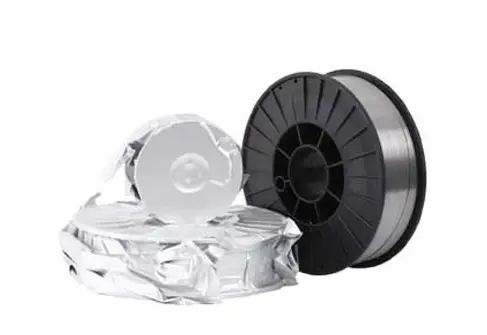
For outdoor onsite repairs or mobile maintenance welding where carrying bulky high-pressure shielding gas cylinders is highly impractical, a premium hardfacing flux cored welding wire engineered for open-arc deployment is the definitive industry standard.
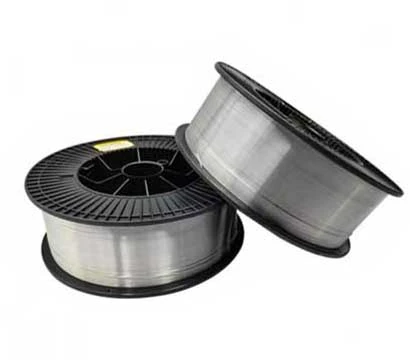
A specialized gasless hardfacing mig wire contains advanced chemical deoxidizers and slag-forming agents within its hollow core. When exposed to the electric arc, these core ingredients react to generate an instantaneous protective gas shield and a rapid-freezing slag layer over the molten metal. This completely insulates the high-chromium overlay weld pool from atmospheric oxygen and nitrogen, preventing porosity even in windy field conditions. It is widely deployed to reinforce agricultural machinery, bulldozer blades, and crusher hammers.
Submerged Arc Welding (SAW) Flux Cored Wire (Factory Production)
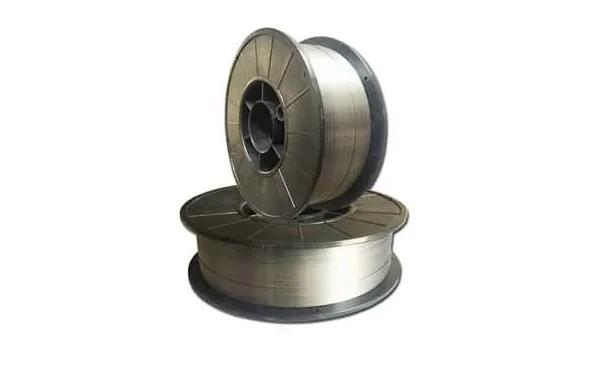
Conversely, for massive, high-volume factory rebuilding—such as remanufacturing steel mill rollers or large cement grinding discs—the china saw hardfacing flux cored wire method is preferred. This system runs a continuous alloy wire under a deep, separate blanket of granular fusible flux.
Because the arc is completely buried beneath the flux powder, it eliminates arc flash, minimizes smoke, and allows for extremely high welding currents and massive deposition rates. The thick granular layer slows the cooling rate of the chromium-carbide matrix, resulting in an exceptionally uniform, ultra-hard overlay free of atmospheric contaminants.
2. Special Alloy Fabrication: When to Use ER321 and ER5556 Welding Wire
Beyond hard-surfacing worn steel parts, heavy industrial fabrication frequently demands jointing highly specialized alloys that must withstand chemical attack or maintain extreme structural shear strength.
High-Temperature Stainless Steel: ER321
Standard stainless steel consumables often fail when continuously exposed to high operating temperatures due to a phenomenon called chromium carbide precipitation (weld decay), which triggers severe intergranular corrosion. To prevent this chemical failure in aerospace exhaust networks or petrochemical piping, utilizing a certified mh-er321 stainless steel solid welding wire is mandatory.
The er321 alloy formulation is meticulously stabilized with titanium. Because titanium has a much stronger chemical affinity for carbon than chromium does, it preferentially forms titanium carbides during heating. This leaves the crucial chromium distributed evenly throughout the matrix, preserving the steel’s fundamental rust- and oxidation-resistant defenses at temperatures up to $816^\circ\text{C}$.
High-Strength Marine Aluminum: ER5556
In maritime engineering, military armor fabrication, and high-pressure cryogenic vessel construction, aluminum structures must deliver superior tensile strength and resistance to saltwater degradation. For these stringent parameters, utilizing standard commercial-grade aluminum fillers is insufficient.
Specifying heavy-duty aluminum magnesium welding wire er5556 ensures that the weld metal matches the exact high-magnesium mechanical chemistry of 5xxx-series base alloys (such as 5456). The er5556 welding wire is enhanced with strict amounts of magnesium and manganese, which significantly refines the solidified grain structure, increases shear strength, and eliminates hot-cracking vulnerabilities in heavy-duty structural joints.
3. Industrial Wear-Resistance & Special Alloy Selection Matrix
To streamline your workshop's material procurement and ensure maximum overlay performance, use the comprehensive technical breakdown below to match your operational environment with the correct chemical grade:
Product Category | Core Specification | Alloy Base Matrix | Primary Resistance Feature | Target Industrial Components |
Hardfacing Cored Wire | Open-Arc / Gasless | High-Chromium Carbide | Severe sliding abrasion & moderate impact | Excavator bucket teeth, cement chutes, conveyor screws, agricultural tillers. |
Special Stainless Wire | AWS A5.9 ER321 | Titanium-Stabilized Austenitic | High-temperature oxidation & weld decay | Petrochemical pipes, aerospace exhaust manifolds, boiler tubes, heat exchangers. |
Marine Aluminum Wire | AWS A5.10 ER5556 | High Magnesium-Manganese | Marine corrosion & maximum weld shear strength | Aluminum ship hulls, military armor plating, pressure vessels, structural storage tanks. |
Alloy Carbide Rod | AWS A5.13 D212 | Tungsten Carbide Grit | Extreme mineral/earth abrasion & high stress | Oil drilling bits, tunnel boring cutters, concrete mixers, mining scraper blades. |
If you prefer traditional stick welding for localized maintenance or manual repair tasks rather than automated wire feeding systems, exploring the exact metallurgical characteristics of your rods is vital. Read our exhaustive industrial guide on the Types of Welding Electrodes and Their Uses to perfectly align manual flux chemistries with your base metals.
Please keep in mind that running continuous, thick-diameter hardfacing wires or dense tungsten carbide welding electrodes layers demands massive electrical currents and high duty cycles. For heavy-duty operations that require continuous, multi-hour overlay production without overheating your power grid, check out the parameters of our industrial-grade, three-phase MMA 250 Inverter Welding Machine systems.
4. Technical FAQ for Advanced Alloy Engineering
Q1: Can a gasless hardfacing wire be used to repair parts subject to severe impact?
A1: It depends on the specific carbide structure. Standard high-chromium gasless hardfacing mig wire formulas develop a microscopic structure packed with chromium carbides ($Cr_7C_3$). This matrix is incredibly hard and offers world-class resistance to sliding earth abrasion, but it can be brittle under heavy, pounding impact (such as large rock-crusher jaws). For extreme-impact environments, you must first apply a tough, impact-absorbing cushioning layer using an austenitic manganese electrode, followed by a final cap of chromium carbide wire to prevent the overlay from spalling or cracking off.
Q2: What makes a carbide welding rod superior for severe mining excavation tools?
A2: A specialized carbide welding rod (such as a tungsten carbide matrix rod) is unique because it does not melt into a homogeneous alloy fluid. Instead, the arc deposits ultra-hard, solid crushed tungsten carbide particles directly into a tough, molten steel or nickel binding matrix. As the tool works, the softer binding matrix wears down slightly, exposing the microscopic, razor-sharp tungsten carbide particles. This creates a self-sharpening, micro-cutting edge that can withstand extreme earth grinding long after standard tool steels have worn completely away.
Q3: Why is continuous gas shielding required when running ER321 stainless steel TIG rods?
A3: Because the er321 tig rod alloy contains active titanium elements, the molten weld pool is extremely sensitive to atmospheric contamination. If even a tiny amount of oxygen or nitrogen enters the arc zone, the titanium will oxidize instantly, forming titanium oxides instead of protective carbides. This ruins the stabilizer distribution and causes severe weld porosity. Always use 99.99% pure Argon shielding gas and maintain a strict trailing gas shield until the weld bead has cooled below the oxidation temperature threshold.