Choosing the right H beam production line requires more than comparing machine prices. The equipment must match your maximum beam dimensions, plate thickness, welding process, production capacity, workshop space and material-handling requirements. A properly configured line can reduce repeated workpiece transfers, improve dimensional consistency and simplify H- and T-beam fabrication.
This guide explains the main technical factors to evaluate before selecting an H beam welding machine or requesting a quotation from a supplier.
1. Define the H Beam Size Range
The beam size range determines the required machine model, clamping capacity, conveyor width and straightening force.
Start by confirming the minimum and maximum dimensions of the H beams you plan to manufacture. Do not select a machine only according to your current average workpiece. The production line should also accommodate your largest expected beam.
Minimum and maximum web height
Web plate thickness
Minimum and maximum flange width
Flange plate thickness
Finished beam length
H beam or T beam production requirements
For example, Minghua’s LMZ-1500 model supports web heights up to 1,500 mm and flange widths up to 600 mm. The LMZ-1800 model supports web heights up to 1,800 mm and flange widths up to 800 mm. Both models can process workpiece lengths from 4 to 15 m within their specified plate-thickness ranges.
Manufacturers producing larger structural beams should also consider whether the workshop crane, loading system and output conveyor can handle the maximum workpiece weight and length.
2. Choose the Required Production-Line Configuration
An H beam production line may use separate machines or an integrated system that combines assembly, welding and straightening.
A conventional line normally includes an H beam assembling machine, a gantry welding machine, a flange straightening machine and multiple transfer conveyors. This arrangement provides configuration flexibility but requires more floor space and additional workpiece handling.
A 3-in-1 H beam production line combines plate positioning, beam assembly, tack welding, submerged arc welding and flange straightening in one coordinated system. It is suitable for manufacturers seeking a more compact workflow for repetitive H- and T-beam fabrication.
| Selection Factor | 3-in-1 H Beam Line | Conventional Separate Line |
|---|---|---|
| Equipment arrangement | Integrated assembly, welding and straightening | Separate machines for each process |
| Workpiece transfer | Reduced between major processes | Multiple transfers are normally required |
| Workshop space | More compact layout | Requires a longer production area |
| Configuration flexibility | Coordinated integrated system | Each machine can be configured separately |
| Suitable application | Continuous production within the specified beam range | Projects requiring separate processing stations |
The correct choice depends on your beam range, product variety, available floor space and preferred production method. Buyers evaluating several factory configurations can also review other automatic welding production lines before finalizing the layout.
3. Check the Welding Process and Power Source
The welding system must match the steel grade, plate thickness, joint design and required deposition rate.
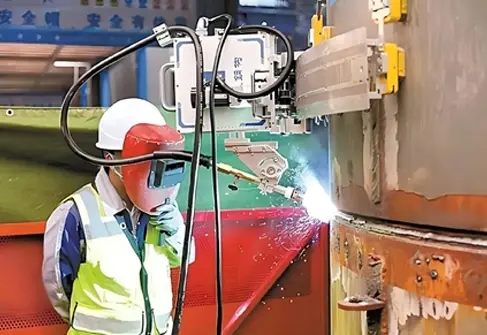
Most automatic H beam welding lines use submerged arc welding for the main longitudinal seams. Before selecting the machine, confirm the required welding current, wire diameter, travel speed and number of welding heads.
Important questions include:
What steel grades will be welded?
What is the maximum flange and web thickness?
Will one or two seams be welded during each pass?
What welding wire diameter will be used?
Is a flux recovery system required?
Which welding power source is compatible with the procedure?
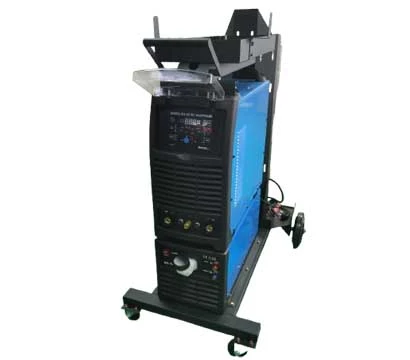
The selected submerged arc welding power source should provide stable output within the required process range. Welding parameters should be confirmed through procedure qualification and production trials rather than estimated only from the machine’s maximum current.
4. Evaluate Centering, Clamping and Tack Welding
Accurate centering and stable clamping help maintain the position of the web and flange plates before continuous seam welding.
An automatic H beam welding machine should include suitable mechanisms for web centering, flange positioning and hydraulic or mechanical clamping. These components affect assembly accuracy and reduce the need for repeated manual adjustment.
When comparing machines, check:
The number and position of centering mechanisms
The supported web and flange adjustment ranges
The clamping method and hydraulic pressure control
How the system controls web-end movement
Whether automatic tack welding is included
How quickly the machine can be adjusted for a new beam size
Automatic tack welding secures the assembled beam before submerged arc welding. However, the tack-welding configuration must still match the plate thickness, joint condition and production procedure.
5. Confirm the Flange Straightening Capacity
The flange straightening unit corrects deformation created by welding heat and helps restore the required beam geometry.
Thicker or wider flange plates may require greater straightening capacity. Before purchasing the line, provide the supplier with the maximum flange width, thickness, material grade and expected deformation condition.
Do not evaluate straightening capacity only by the machine’s nominal model. Ask the manufacturer to confirm the applicable material and thickness range. For critical products, request a trial using a workpiece that is similar to your actual H beam.
6. Calculate the Required Production Capacity
Production capacity depends on welding speed, beam size, seam requirements, material handling and the time required for model changes.
A higher maximum conveying speed does not automatically mean a higher daily output. The actual production rate is also affected by loading, centering, tack welding, welding procedure, straightening and finished-beam removal.
Prepare the following information before discussing capacity with a supplier:
Expected number of beams per shift
Typical beam dimensions and length
Number and length of weld seams
Number of production shifts per day
Required model-change frequency
Available loading and unloading equipment
Ask the supplier to explain how the capacity estimate is calculated. The estimate should be based on your representative workpiece rather than the machine’s unloaded travel speed.
7. Check the Workshop Layout and Material Flow
The production-line layout must provide sufficient space for loading, processing, unloading, maintenance and safe operator access.
Machine length is only one part of the installation requirement. The complete layout may also include input and output roller conveyors, welding power sources, hydraulic stations, electrical cabinets, flux recovery equipment and crane operating areas.
Before placing an order, confirm:
Available workshop length and width
Foundation and floor-loading requirements
Crane capacity and lifting height
Input and output material-flow direction
Maintenance access around the machine
Local power supply and voltage
Fume extraction and workshop ventilation
Providing a workshop drawing allows the manufacturer to recommend a more practical equipment arrangement and conveyor length.
8. Compare Automation and Control Functions
The appropriate automation level should reduce repetitive adjustment without making operation unnecessarily complicated.
Useful control functions may include variable-frequency conveying, coordinated hydraulic clamping, automatic tack welding, welding-speed adjustment and centralized operation. The exact configuration should match the skills of your operators and the variety of beams being produced.
When reviewing automatic welding equipment, ask the supplier to demonstrate:
Beam-size adjustment procedures
Welding-speed control
Hydraulic clamping operation
Emergency-stop locations
Fault alarms and troubleshooting
Parameter storage, if available
A clear control interface and accessible maintenance points can be more valuable than adding functions that operators rarely use.
9. Review Machine Quality and Supplier Support
A reliable H beam production line supplier should provide verifiable machine specifications, testing procedures and technical support.
Before purchasing, request evidence that helps confirm the supplier’s manufacturing and service capability:
Machine drawings and technical specifications
Factory testing videos
Welding samples produced by a similar machine
Electrical and hydraulic documentation
Installation and commissioning plan
Operator training information
Recommended spare-parts list
Warranty and technical-support terms
For structural steel applications, buyers can also evaluate whether the supplier understands the complete structural steel welding process, rather than only supplying an individual machine.
10. Understand What Affects the H Beam Production Line Price
The H beam production line price depends on machine capacity, welding configuration, conveyor length, automation level and project-specific options.
The lowest quotation may not include the same equipment scope as a more complete offer. Compare quotations line by line instead of comparing only the total price.
Common price factors include:
Maximum web height and flange width
Supported plate-thickness range
LMZ-1500, LMZ-1800 or customized configuration
Welding power source and number of welding units
Input and output conveyor length
Flux recovery equipment
Hydraulic and electrical components
Voltage customization
Installation, commissioning and training
Optional material-handling equipment
Ask each supplier to clearly identify the standard configuration, optional equipment, excluded items, delivery terms and installation responsibilities.
H Beam Production Line Selection Checklist
A complete selection checklist helps the manufacturer recommend the correct model and prepare an accurate quotation.
| Information Required | Details to Provide |
|---|---|
| Web dimensions | Minimum and maximum height and thickness |
| Flange dimensions | Minimum and maximum width and thickness |
| Beam length | Minimum, typical and maximum workpiece length |
| Material | Steel grade and representative drawings |
| Welding process | Wire diameter, seam type and welding procedure |
| Production target | Beams per shift or monthly output |
| Workshop | Layout, crane capacity and available installation space |
| Electrical supply | Voltage, frequency and phase |
| Required service | Installation, commissioning, training and spare parts |
Frequently Asked Questions
What is the most important factor when selecting an H beam production line?
The most important factor is whether the machine can process your maximum web height, flange width, plate thickness and beam length. Production capacity, welding procedure and workshop space should then be evaluated.
Should I choose an integrated or conventional H beam welding line?
An integrated line is suitable when you want to reduce workpiece transfers and use a compact coordinated system. A conventional line may be preferred when separate processing stations or a different production arrangement are required.
How do I choose between LMZ-1500 and LMZ-1800?
Choose the model according to the largest beam dimensions. The LMZ-1500 supports web heights up to 1,500 mm and flange widths up to 600 mm, while the LMZ-1800 supports web heights up to 1,800 mm and flange widths up to 800 mm.
Can an H beam production line manufacture T beams?
Yes. A properly configured integrated line can assemble, weld and process both H-shaped and T-shaped steel sections within the machine’s specified dimensional range.
What information is needed to calculate the machine price?
Provide the beam dimensions, plate thickness, workpiece length, steel grade, welding process, production target, local voltage and required auxiliary equipment.
Can the production line be customized?
The conveyor length, welding power source, electrical system, material-handling arrangement and other configurations may be adjusted according to the project requirements and supplier capabilities.
Conclusion
The right H beam production line should match your maximum beam dimensions, welding procedure, output target and workshop conditions. Before requesting a quotation, prepare representative beam drawings, dimensional ranges and production requirements. Minghua can use this information to recommend a suitable LMZ configuration, welding system and production-line layout.
Send your H beam specifications and workshop layout to receive a recommended machine configuration and quotation.