A 3-in-1 H beam welding line integrates beam assembly, tack welding, submerged arc welding and flange straightening into one coordinated system, while a conventional production line uses separate machines for the main processing stages.
Neither configuration is suitable for every steel fabrication project. The right choice depends on beam dimensions, product variety, required output, workshop space, material-handling conditions and future production plans. This guide compares the two systems to help structural steel manufacturers select a practical H beam production line.
What Is a 3-in-1 H Beam Welding Line?
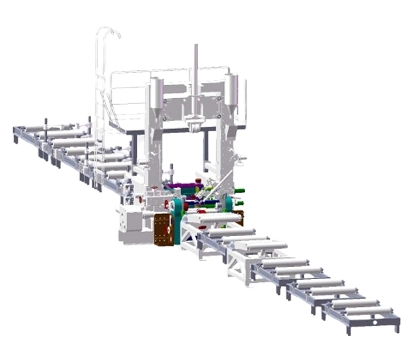
A 3-in-1 H beam welding line is an integrated machine that combines H beam assembly, welding and flange straightening within one production system.
The web plate and flange plates are loaded onto the roller conveyor, aligned by centering mechanisms and secured by mechanical or hydraulic clamping. After tack welding, the assembled beam passes through the submerged arc welding section and then enters the flange straightening unit.
Minghua’s 3-in-1 H beam production line is available in LMZ-1500 and LMZ-1800 configurations. The appropriate model should be selected according to the maximum web height, flange width, plate thickness and workpiece length.
What Is a Conventional H Beam Production Line?
A conventional H beam production line uses separate machines to complete beam assembly, submerged arc welding and flange straightening.
A typical conventional line may include:
H beam assembly machine
Tack-welding equipment
Gantry or column-type submerged arc welding machine
Flange straightening machine
Input and output roller conveyors
Transfer equipment between workstations
Welding power sources and flux recovery systems
Because each process is completed at an independent station, a conventional line offers greater flexibility when different machines, processing methods or workpiece routes are required. However, it normally needs a larger workshop layout and more material transfers.
3-in-1 vs Conventional H Beam Welding Line
The main difference is whether assembly, welding and straightening are integrated into one system or divided among separate production stations.
| Comparison Factor | 3-in-1 H Beam Welding Line | Conventional H Beam Line |
|---|---|---|
| Equipment arrangement | Assembly, welding and straightening are integrated | Each process uses a separate machine |
| Workpiece transfer | Reduced between the main processing stages | Multiple transfers are normally required |
| Workshop layout | Relatively compact | Requires more space for machines and conveyors |
| Process coordination | Operations are coordinated within one system | Each workstation operates independently |
| Configuration flexibility | Based on the integrated machine design | Individual machines can be selected separately |
| Material handling | Simpler continuous workflow | Requires handling between stations |
| Product variety | Suitable for repeated production within a defined size range | Suitable for varied workflows and separate processing requirements |
| Maintenance | Integrated systems require coordinated maintenance | Each machine can be maintained independently |
| Future expansion | Expansion depends on the integrated configuration | Individual stations can be added or replaced |
Which System Requires Less Workshop Space?
A 3-in-1 H beam welding line generally requires a more compact processing area because several production stages are combined.
A conventional line needs space for separate assembly, welding and straightening machines, as well as transfer conveyors and crane operating areas. The total installation length can therefore be considerably greater than the dimensions of any individual machine.
However, buyers should not compare machine dimensions alone. The final workshop layout must also account for:
Input plate loading area
Finished beam unloading area
Roller conveyor length
Crane movement and lifting clearance
Welding power sources
Hydraulic and electrical cabinets
Flux recovery equipment
Maintenance and operator access
Before selecting either system, provide the supplier with a workshop drawing showing the available length, width, entrances, columns, crane position and intended material-flow direction.
How Do the Two Lines Handle Material Flow?
Material flow describes how the plates and assembled beams move between loading, assembly, welding, straightening and unloading.
In a 3-in-1 system, the beam remains on a coordinated roller-conveyor path during the main production stages. This can reduce repeated crane lifting and repositioning between separate machines.
In a conventional line, the workpiece must normally move from the assembly machine to the welding station and then to the straightening machine. This arrangement may be appropriate when the factory already has suitable conveyors, cranes or independent processing areas.
When comparing both options, evaluate the complete material route rather than only the operating speed of the welding unit. Loading delays, crane availability, turning requirements and finished-beam removal can all affect actual production flow.
Which Line Offers More Production Flexibility?
A conventional H beam line generally offers greater flexibility because each processing station can be configured and operated independently.
Separate machines may be preferable when a factory produces a wide range of beam dimensions, uses different welding arrangements or needs certain workpieces to bypass one production stage.
A 3-in-1 line is more suitable when the manufacturer repeatedly produces H or T beams within the integrated machine’s specified dimensional range. It provides a coordinated workflow but should not be assumed to process every beam size or structural profile.
Before choosing, confirm:
Maximum web height and thickness
Maximum flange width and thickness
Minimum and maximum beam length
H beam and T beam production requirements
Steel grades and joint designs
Frequency of product-size changes
Future product expansion plans
How Do Welding Configurations Compare?
Both integrated and conventional H beam lines commonly use submerged arc welding for the main longitudinal seams.
The welding configuration may include one or more power sources, welding heads, wire-feeding systems and flux recovery units. The correct setup depends on the steel grade, plate thickness, seam design, welding position and required production capacity.
A conventional line may allow the welding station to be configured independently from the assembly and straightening machines. A 3-in-1 line coordinates welding with the integrated conveying, clamping and straightening process.
The selected submerged arc welding power source should match the approved welding procedure rather than being chosen only according to maximum rated current.
Which System Is Easier to Operate?
Operating difficulty depends on the control design, level of automation, product variety and skills of the production team.
A 3-in-1 machine centralizes several operations and may simplify coordination between assembly, welding and straightening. Operators still need to understand plate loading, centering, hydraulic clamping, tack welding, welding parameters and size adjustment.
A conventional line divides responsibility among separate stations. This can provide process flexibility, but it may require more coordination between machine operators, crane operators and material-handling personnel.
Before purchasing, ask the supplier to demonstrate:
Beam-size adjustment procedures
Web and flange centering
Hydraulic clamping operation
Tack-welding procedures
Welding-speed adjustment
Emergency-stop functions
Common alarm and troubleshooting procedures
How Do Maintenance Requirements Differ?
A 3-in-1 line concentrates several processing functions in one system, while a conventional line separates maintenance among individual machines.
Integrated equipment requires coordinated inspection of the conveyor, centering system, hydraulic components, welding equipment and straightening unit. A failure in one major section may affect the complete workflow until the problem is resolved.
With a conventional line, each machine can usually be serviced independently. However, the factory must maintain more separate machines, conveyors, controls and transfer systems.
For either option, request:
Preventive maintenance schedule
Electrical and hydraulic diagrams
Lubrication instructions
Recommended spare-parts list
Troubleshooting documentation
Remote technical-support terms
Operator and maintenance training
Which H Beam Welding Line Costs More?
The total investment depends on machine capacity, equipment scope, automation level, welding configuration, conveyors and installation requirements.
A 3-in-1 machine combines several functions in one system, but its quotation may not include every item required for installation and operation. A conventional line includes more individual machines and transfer equipment, although existing workshop equipment may sometimes be reused.
Important cost factors include:
Maximum beam dimensions
Supported plate-thickness range
Number and capacity of welding power sources
Conveyor length
Hydraulic configuration
Flux recovery equipment
Electrical voltage and control components
Material-handling equipment
Installation and commissioning
Operator training and spare parts
Compare the full equipment scope instead of relying only on the total quotation. Each supplier should clearly identify standard equipment, optional equipment, excluded items and installation responsibilities.
When Should You Choose a 3-in-1 H Beam Welding Line?
A 3-in-1 line is suitable for manufacturers that need a compact and coordinated workflow for H- and T-beam production within a defined size range.
Consider an integrated system when:
Workshop length is limited
Repeated workpiece transfers should be reduced
Beam dimensions fall within the machine’s processing range
Production focuses on repetitive H- or T-beam fabrication
Centralized operation is preferred
The factory does not require each process to operate independently
Minghua’s LMZ-1500 and LMZ-1800 systems combine assembly, tack welding, submerged arc welding and flange straightening. Buyers should select the model according to the maximum workpiece dimensions rather than the average beam size.
When Should You Choose a Conventional H Beam Line?
A conventional line is suitable when the factory requires separate processing stations, greater configuration flexibility or independent machine operation.
Consider a conventional configuration when:
The factory produces a wide variety of beam sizes
Different workpieces follow different processing routes
Assembly, welding and straightening must operate independently
The workshop already has conveyors or compatible equipment
Future expansion may involve replacing one station at a time
Large or specialized workpieces exceed the integrated machine range
Manufacturers comparing different configurations can review Minghua’s range of automatic welding production lines and automatic welding equipment.
Selection Checklist
A useful comparison should be based on the buyer’s actual workpieces, workshop conditions and production objectives.
| Project Information | Questions to Confirm |
|---|---|
| Beam size | What are the maximum web height, flange width and plate thickness? |
| Beam length | What are the typical and maximum workpiece lengths? |
| Product variety | How frequently will the beam dimensions change? |
| Production target | How many beams are required per shift or month? |
| Welding process | Which steel grade, wire diameter and welding procedure will be used? |
| Workshop layout | How much installation and material-handling space is available? |
| Existing equipment | Can current cranes, conveyors or welding power sources be reused? |
| Expansion plan | Will the factory add new beam sizes or production stations later? |
| Technical support | Are installation, training, spare parts and remote support required? |
Frequently Asked Questions
What does a 3-in-1 H beam welding line include?
A 3-in-1 line integrates beam assembly, tack welding, submerged arc welding and flange straightening into one coordinated machine and conveyor system.
Is a 3-in-1 line suitable for every H beam size?
No. Every machine has specified limits for web height, flange width, plate thickness and workpiece length. The buyer must compare these limits with the largest planned beam.
Can a conventional H beam line produce more beam sizes?
A conventional line may offer greater configuration flexibility because the assembly, welding and straightening machines are selected separately. The actual processing range still depends on each machine.
Which system needs less material handling?
A 3-in-1 line generally reduces transfers between the main processing stages. A conventional line normally requires the beam to move between separate assembly, welding and straightening stations.
Which H beam line is better for a small workshop?
An integrated line may be more suitable when workshop length is limited, provided the required beam dimensions and production process fall within the machine’s operating range.
What information is required for a quotation?
Provide the web height and thickness, flange width and thickness, beam length, steel grade, welding process, required output, workshop layout and local power supply.
Conclusion
A 3-in-1 H beam welding line provides a compact, coordinated workflow for assembly, welding and straightening. A conventional line provides independent processing stations and greater configuration flexibility. The correct system depends on beam dimensions, product variety, production targets, workshop layout and future expansion plans.
Send Minghua your representative H beam drawings, dimensional range and workshop layout to receive a recommended production-line configuration and quotation.