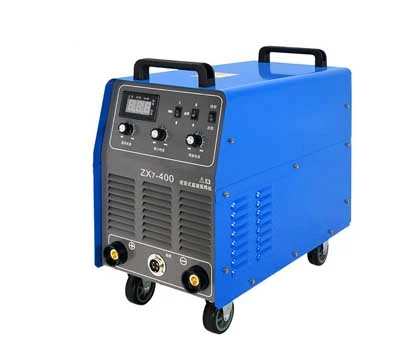
Choosing between the ZX7-400, ZX7-500 and ZX7-630 welding machines is mainly a question of required welding current, continuous workload, power capacity and equipment size. All three Minghua models are three-phase 380V industrial MMA/ARC welding machines, but their maximum and continuous output capacities are different.
According to current Minghua product data, the ZX7-400T provides an output range of 40–400A, the ZX7-500T provides 40–500A, and the ZX7-630T provides 40–630A. At 40°C, their listed 100% duty-cycle outputs are 310A, 387A and 488A respectively.
This comparison explains what those differences mean in actual machine selection, why maximum amperage should not be the only purchasing criterion, and how industrial buyers can choose a ZX7 model according to workload rather than simply buying the machine with the highest number.
ZX7-400 vs ZX7-500 vs ZX7-630: Quick Comparison
The most useful way to compare these three machines is to look at both maximum output current and the current available at a 100% duty cycle. Maximum amperage shows peak capacity, while continuous-duty current gives a better indication of sustained industrial workload.
| Specification | ZX7-400T | ZX7-500T | ZX7-630T |
| Input Power | 3-phase AC 380V ±10%, 50/60Hz | 3-phase AC 380V ±10%, 50/60Hz | 3-phase AC 380V ±10%, 50/60Hz |
| Output Current Range | 40–400A | 40–500A | 40–630A |
| Output at 60% Duty Cycle | 400A | 500A | 630A |
| Output at 100% Duty Cycle | 310A | 387A | 488A |
| No-Load Voltage | 70V | 70V | 90V |
| Efficiency | ≥89% | ≥92% | ≥89% |
| Dimensions | 471 × 252 × 468 mm | 471 × 252 × 468 mm | 557 × 280 × 540 mm |
| Host Weight | 21.5 kg | 23 kg | 39.5 kg |
| Best Selection Logic | Lower-current industrial MMA work where 400A maximum capacity is sufficient | Higher sustained output without the size and weight of the 630 model | Highest output and continuous-current requirement among the three models |
How Does Output Current Differ Between ZX7-400, ZX7-500 and ZX7-630?
The model number provides a useful indication of the maximum output range, but industrial buyers should distinguish between maximum available current and the current they actually expect to use during production.
ZX7-400T: 40–400A
The ZX7-400T offers the lowest maximum output of the three models, but 400A is still a substantial industrial MMA current range. It is the logical starting point when the required welding procedure remains comfortably inside the machine's available current and duty-cycle capacity.
ZX7-500T: 40–500A
The ZX7-500T increases maximum output by 100A while retaining the same listed external dimensions as the ZX7-400T. Its 100% duty-cycle output also increases from 310A to 387A, making the 500 model relevant when sustained operating current is more important.
ZX7-630T: 40–630A
The ZX7-630T provides the largest current range and highest continuous-current capacity. However, this additional capacity also comes with a larger enclosure and a listed host weight of 39.5 kg, so buyers should choose it because their workload requires the additional output rather than simply because it has the highest model number.
Why Duty Cycle Matters More Than Maximum Amperage Alone
Maximum current tells only part of the story. For production welding, duty cycle helps show how much output a power source can sustain over a defined operating period before thermal limits require reduced welding time.
Welding equipment manufacturers commonly express duty cycle as a percentage of a 10-minute period. For example, a 60% duty cycle corresponds to six minutes of welding within that period at the specified output, followed by the required cooling interval. For a general explanation, see Miller's welding duty-cycle guide.
For the Minghua ZX7 series, the more useful purchasing comparison is therefore not simply 400A vs 500A vs 630A:
Which ZX7 Welding Machine Should You Choose?
There is no single “best” ZX7 machine for every workshop. The correct model is the one whose output and duty-cycle capacity match the welding procedure without purchasing unnecessary capacity.
Choose ZX7-400T When 400A Maximum Output Is Enough
The ZX7-400T is the most compact choice in terms of capacity and has the lowest listed host weight at 21.5 kg. It is appropriate when the qualified welding procedures do not require the additional current capacity of the ZX7-500T or ZX7-630T.
Choose ZX7-500T When You Need More Continuous Capacity
The ZX7-500T raises the 100% duty-cycle output to 387A while its listed dimensions remain the same as the ZX7-400T. This makes it a practical middle option for buyers who need higher sustained output but do not require the maximum capacity of the 630 model.
Choose ZX7-630T When the Welding Procedure Requires the Highest Output
The ZX7-630T should be evaluated when high-current procedures or sustained workloads require more capacity than the 400 or 500 models can provide. Its 488A output at 100% duty cycle is the highest of the three, but the machine is also physically larger and significantly heavier.
ZX7-400 vs ZX7-500: Is the 500 Model Worth Choosing?
For many industrial buyers, ZX7-400 vs ZX7-500 is the most relevant comparison because the two machines have the same listed dimensions and only a small difference in host weight: 21.5 kg versus 23 kg.
The larger difference is electrical output. ZX7-500T increases maximum output from 400A to 500A and raises the listed 100% duty-cycle current from 310A to 387A.
ZX7-500 vs ZX7-630: When Do You Need the Larger Machine?
Moving from ZX7-500T to ZX7-630T is a more substantial step. Maximum output increases from 500A to 630A, while 100% duty-cycle output rises from 387A to 488A.
At the same time, host weight increases from 23 kg to 39.5 kg and the enclosure grows from 471 × 252 × 468 mm to 557 × 280 × 540 mm.
For this reason, the ZX7-630T is most logical when the welding procedure genuinely requires its additional current capacity. If actual production current remains within the ZX7-500T's continuous operating range, selecting the 630 solely because it is the largest model may provide limited operational value.
Why You Should Not Choose a ZX7 Welder by Maximum Amperage Alone
A common purchasing mistake is assuming that a larger amperage number automatically means a better welding machine for every job. In practice, excessive unused capacity can increase equipment size and purchasing requirements without improving the weld if the approved process operates at much lower current.
Before selecting ZX7-400, ZX7-500 or ZX7-630, evaluate at least the following factors:
ZX7 Welding Machine Selection Checklist for Industrial Buyers
| Information | What to Confirm |
| Required Current | Normal and maximum welding amperage used by your procedures |
| Duty Cycle | Required continuous operating current and workload duration |
| Input Supply | Available three-phase supply and site electrical conditions |
| Application | Fabrication, maintenance, site welding or other industrial workload |
| Mobility | Whether machine size and weight affect installation or movement |
| Cable Length | Required work distance and customized cable requirements |
| Optional Functions | VRD, generator compatibility, wired or wireless remote-control requirements |
| Purchasing | Quantity, destination, required accessories and other order requirements |
Need the Full ZX7-400 / ZX7-500 / ZX7-630 Product Specification?
For Minghua-specific output range, duty-cycle data, efficiency, machine dimensions, weight and available functions, view the ZX7 MMA ARC welding machine product page.
FAQ About ZX7-400, ZX7-500 and ZX7-630 Welding Machines
What is the main difference between ZX7-400, ZX7-500 and ZX7-630?
The main differences are maximum output current, continuous-duty output, machine size and weight. Minghua's current specifications list 40–400A for ZX7-400T, 40–500A for ZX7-500T and 40–630A for ZX7-630T.
What is the duty cycle of the ZX7-400 welding machine?
Current Minghua data lists ZX7-400T at 400A with a 60% duty cycle at 40°C and 310A at a 100% duty cycle.
What is the duty cycle of the ZX7-500 welding machine?
Minghua's current specification lists 500A at a 60% duty cycle and 387A at a 100% duty cycle at 40°C.
When should I choose ZX7-630 instead of ZX7-500?
Consider ZX7-630T when the qualified welding procedures or continuous workload require more current capacity than ZX7-500T can provide. The 630 model offers a higher maximum and continuous-duty output, but it is also larger and heavier.
Is ZX7-500 always better than ZX7-400?
No. ZX7-500T provides more current capacity, but that additional capacity is only useful when the welding procedure or workload requires it. If the required operating current remains within ZX7-400T's capacity, the smaller model may be sufficient.
What information should I provide when requesting a ZX7 welding machine quotation?
Provide your normal and maximum welding current, workload and duty-cycle requirements, available power supply, application, required cable length, optional functions, order quantity and destination. These details help determine whether ZX7-400T, ZX7-500T or ZX7-630T is the more appropriate model.
Conclusion: Match the ZX7 Model to the Real Welding Load
The key difference between ZX7-400, ZX7-500 and ZX7-630 is not simply the number printed in the model name. Industrial buyers should compare both maximum current and continuous-duty current against the actual welding procedure.
ZX7-400T is appropriate when its 400A maximum and 310A continuous-duty capacity cover the required workload. ZX7-500T provides a useful increase in output while retaining similar dimensions to the 400 model. ZX7-630T provides the greatest current capacity, but its additional size and weight make the most sense when the project genuinely requires the higher output.