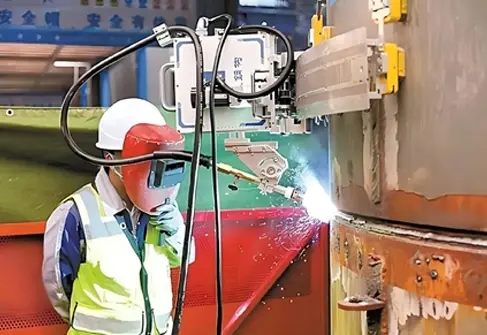
SUBMERGED ARC WELDING CONSUMABLE SELECTION Selecting a submerged arc welding wire without considering the flux, welding current, polarity and required weld properties can lead to inconsistent results. In SAW, the wire and flux should be treated as a complete welding-consumable system rather than two unrelated materials.
In submerged arc welding (SAW), both the electrode wire and welding flux influence the chemistry, mechanical properties, bead profile and operating behavior of the weld. This makes SAW consumable selection different from simply choosing a filler wire by base-metal grade.
According to TWI's technical guidance on submerged arc welding consumables, the wire and flux both affect deposited-weld-metal composition and mechanical performance. For industrial buyers, welding engineers and fabrication plants, this means the correct question is not simply “Which SAW wire should I buy?” but rather “Which wire-flux combination fits the base material, welding procedure and required properties?”
If you are also selecting the welding power source, Minghua's MZ DC 630 / 1000 / 1250 submerged arc welding machines support different SAW wire-diameter and output ranges for industrial welding application.
Quick SAW Wire & Flux Selection Checklist
1. Start with the base metal. Match the wire chemistry and required deposited-metal properties to the steel, stainless steel or alloy being welded.
2. Select wire and flux as a combination. Do not assume that any SAW wire can be paired with any available flux.
3. Match wire diameter to welding current and productivity. Larger wire can support higher-current applications, but the welding procedure must remain within the qualified operating range.
4. Check toughness, hydrogen and heat-treatment requirements. These factors become especially important in pressure vessels, pipelines, high-strength steels and restrained joints.
5. Confirm current, polarity and travel speed through the WPS. Consumable selection and welding parameters should be validated together rather than independently.
Why SAW Wire and Flux Must Be Selected as a Combination
In submerged arc welding, the wire supplies most of the filler metal, while the flux protects the arc and molten pool, forms slag, influences bead shape and can also affect weld-metal chemistry. As a result, changing the flux while keeping the same wire can change the final weld properties.
This is why welding consumable manufacturers commonly qualify and classify wire-flux combinations rather than treating the flux only as a protective covering. Lincoln Electric, for example, publishes recommended wire combinations and mechanical-property data for specific submerged arc fluxes.
You can review an example in its submerged arc flux and wire combination documentation .
Practical rule: Never approve a SAW consumable solely because the wire classification appears suitable. Check the certified performance of the complete wire-flux combination against the applicable WPS, code and project requirements.
Step 1: Match the SAW Wire to the Base Metal and Required Weld Properties
The first screening factor is the base material. The welding wire should provide the chemistry and mechanical-property range required by the joint design and welding procedure.
| Base Material / Application | Wire Selection Focus | Flux Selection Focus |
| Carbon Steel | Strength level, deoxidation capability and required weld chemistry | General fabrication, bead profile, multi-pass requirements and toughness |
| Low-Alloy / High-Strength Steel | Required strength, alloy content and impact toughness | Low hydrogen, toughness and controlled alloy transfer |
| Stainless Steel | Corrosion resistance and compatibility with the stainless grade | Chemistry control, slag behavior and corrosion-performance requirements |
| Nickel Alloy / Corrosion-Resistant Alloy | Alloy matching, corrosion resistance and high-temperature properties | Flux specifically approved for the selected nickel-alloy wire and service requirement |
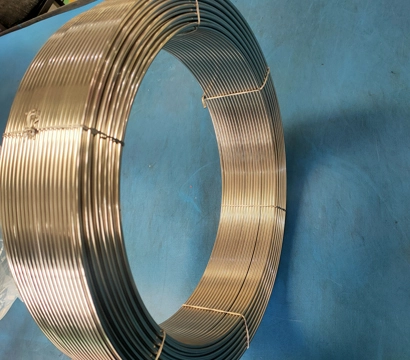
Buyers sourcing SAW wire can also review Minghua's solid welding wire range and confirm the exact wire grade according to base metal, required mechanical properties and qualified welding procedure.
Step 2: Choose the Flux According to Metallurgical and Welding Requirements
SAW flux selection is not only about slag removal or bead appearance. Flux chemistry can influence oxygen level, alloy transfer, weld-metal toughness and operating behavior.
| Flux Category | General Characteristic | Typical Selection Consideration |
| Neutral Flux | Designed to have relatively limited influence on deposited-weld-metal chemistry | Useful where consistent chemistry is important, particularly in multi-pass procedures |
| Active Flux | Can contribute elements such as manganese or silicon to the weld deposit | Often considered for selected single-pass or limited-pass applications where operating performance is important |
| Basic / Highly Basic Flux | Designed for cleaner weld metal and demanding mechanical-property requirements | Frequently considered where impact toughness, low-temperature performance or high-quality structural welding is required |
TWI notes that flux basicity can have a major effect on weld-metal properties, particularly notch toughness. For a deeper technical explanation of neutral, active and basic fluxes, refer to TWI's SAW consumables technical article.
Step 3: Match SAW Wire Diameter to Current and Production Requirements
Wire diameter is closely linked to the usable current range, deposition rate, joint geometry and desired productivity. In general, a larger-diameter wire is selected when the welding system and procedure require higher-current operation, while smaller wire provides different current-density and operating characteristics.
The exact usable range should always come from the approved consumable data sheet and WPS rather than from a universal amperage chart.
Example: Minghua MZ Series Wire-Diameter Capability
| SAW Machine | Rated Output | Listed Wire Diameter |
| MZ630N | 630A | 2.0–3.2 mm |
| MZ1000N | 1000A | 3.2–5.0 mm |
| MZ1250N | 1250A | 3.2–6.0 mm |
These values describe Minghua MZ machine capability and should not be treated as a universal wire-current chart for every SAW consumable or welding procedure.
Step 4: Select Welding Current, Polarity and Travel Speed Together
Welding current is one of the main factors controlling deposition, penetration and heat input in SAW, but it should never be adjusted independently of voltage, travel speed, wire diameter and electrode extension.
DC Electrode Positive (DCEP) Commonly used where stronger penetration characteristics are required. Final suitability depends on the wire-flux combination and qualified procedure.
DC Electrode Negative (DCEN) May be selected in procedures where deposition behavior and lower penetration are advantageous, subject to consumable and procedure approval.
AC Submerged Arc Welding AC can be useful in suitable SAW applications, including situations where control of magnetic arc blow or multi-wire process design is important.
For projects requiring AC/DC flexibility, compare Minghua's MZ AC/DC 1000 / 1250 welding tractor submerged arc welding machines.
Step 5: Check Strength, Toughness, Hydrogen and Heat-Treatment Requirements
Two wire-flux combinations may both produce an acceptable weld bead but deliver different mechanical properties. This becomes especially important in high-strength structural steel, pressure vessels, pipelines, offshore fabrication and low-temperature service.
| Requirement | Why It Matters | What to Confirm |
| Tensile / Yield Strength | The weld deposit must satisfy project strength requirements. | Certified wire-flux combination data. |
| Impact Toughness | Critical for low-temperature or dynamically loaded structures. | Test temperature, flux basicity and combination classification. |
| Diffusible Hydrogen | Important when hydrogen cracking risk must be controlled. | Consumable classification, storage and handling procedure. |
| PWHT | Heat treatment may change weld-metal strength and toughness. | Mechanical properties in the required heat-treated condition. |
This is particularly relevant in pressure vessel welding , where consumable selection may need to account for material grade, toughness, service temperature and post-weld heat treatment.
Flux Storage and Moisture Control Are Part of Consumable Selection
Correct flux selection can still fail in production if the flux absorbs excessive moisture or becomes contaminated during handling and recycling. Moisture management is especially important where low-hydrogen performance is required.
ESAB's technical guidance on handling and storage of submerged arc welding flux explains why moisture exposure, storage conditions, recycling and rebaking procedures need to be controlled.
Important: Do not apply one generic rebaking temperature or holding temperature to every SAW flux. Always follow the specific flux manufacturer's technical data sheet and project procedure.
How SAW Wire & Flux Selection Changes by Application
Structural Steel & H-Beam Production
Productivity, bead profile, slag removal and mechanical properties are major selection factors. Automated beam production may use larger wire sizes and continuous SAW systems. See Minghua's H Steel Beam Production Line for an example of an integrated structural-steel welding system.
Pressure Vessels
Strength, impact toughness, hydrogen control, PWHT behavior and code compliance generally become more important than simply maximizing deposition rate.
Pipelines and Large-Diameter Pipe
Consistent toughness, wire-flux chemistry, multi-wire capability and production repeatability may become critical in high-volume pipe welding.
Stainless and Nickel-Alloy Fabrication
Consumable compatibility and corrosion-resistant weld chemistry should take priority. The flux must be specifically suitable for the selected stainless or nickel-alloy wire.
7 Common SAW Wire & Flux Selection Mistakes
1.
Selecting the wire by tensile strength only and ignoring flux compatibility.
2.
Assuming a larger wire diameter is automatically more productive in every joint.
3.
Using an active flux in a multi-pass procedure without confirming final weld chemistry.
4.
Ignoring impact-toughness requirements when selecting flux.
5.
Choosing current and polarity before confirming the approved wire-flux combination.
6.
Reusing or storing flux without adequate control of moisture, fines and contamination.
7.
Treating published machine capacity as a substitute for WPS qualification and welding trials.
PRACTICAL SELECTION WORKFLOW A Practical 6-Step SAW Consumable Selection Process
Step 1:
Identify the base metal, thickness, joint design and service conditions.
Step 2:
Define required strength, toughness, corrosion resistance and PWHT condition.
Step 3:
Select a candidate SAW wire based on weld-metal chemistry and mechanical properties.
Step 4:
Select a compatible flux and verify the certified wire-flux combination.
Step 5:
Match wire diameter, current, polarity and travel speed to the welding equipment.
Step 6:
Validate the combination through procedure qualification, production trials and applicable code requirements.
What Information Should Buyers Provide When Ordering SAW Wire and Flux?
Providing complete welding information helps avoid selecting a consumable that works operationally but fails to meet the final mechanical-property or qualification requirement.
Base metal grade and thickness
Applicable welding code or project specification
Required tensile strength and yield strength
Impact test temperature and toughness requirement
PWHT requirements
Required SAW wire diameter
Welding current, polarity and travel-speed range
Single-pass, multi-pass or multi-wire procedure
Required certificates, classification and diffusible-hydrogen level
FAQ About Submerged Arc Welding Wire and Flux Selection
Can any submerged arc welding wire be used with any SAW flux?
No. The wire and flux should be evaluated as a qualified combination because both can influence deposited-weld-metal chemistry, mechanical properties and welding behavior.
How do I choose SAW wire diameter?
Select wire diameter according to required welding current, joint design, deposition requirement, welding equipment capability and the qualified procedure. Avoid using wire diameter alone as the basis for current selection.
What is the difference between neutral and active SAW flux?
Neutral flux is designed to have relatively limited influence on deposited-metal chemistry, while active flux may contribute elements such as manganese or silicon. The correct choice depends on the welding procedure and required weld properties.
Is basic flux better for submerged arc welding?
Not in every application. Basic fluxes are often selected where demanding toughness and weld-metal quality are required, but operating characteristics, joint design and production requirements must also be considered.
Does polarity affect SAW penetration?
Yes. DC polarity and AC operation can influence penetration, deposition behavior and arc characteristics. Final polarity should follow the qualified consumable combination and WPS.
Why is flux moisture control important?
Excessive moisture can increase hydrogen-related welding risks and reduce process consistency. Flux should be stored, handled and conditioned according to the manufacturer's technical instructions.
What SAW wire should be used for H-beam welding?
The correct wire depends on structural-steel grade, required mechanical properties, flux combination, welding speed and qualified fabrication procedure. There is no single universal SAW wire for every H-beam project.
Should I select the SAW machine before the wire and flux?
Machine and consumable selection should be coordinated. The required weld properties and WPS define the process window, while the machine must provide the current, polarity, wire-size capability and travel control required by that procedure.
SAW CONSUMABLE SELECTION Need Help Selecting SAW Wire, Flux or Welding Equipment?
Send Minghua your base material, plate thickness, joint design, welding code, required mechanical properties, wire diameter, current range and production requirements. Our team can help evaluate suitable submerged arc welding consumables and equipment for your application.
Contact Minghua